Showing posts with label 1970's. Show all posts

Wednesday, May 23, 2018

ADMIN04 A few notes on the death of Tom Wolfe

If the recent Royal Wedding and school shooting haven't driven you from news coverage, you may have heard that Tom Wolfe died last week (May 14), but it's worth noting here because of the unusual footnote he became in comics history.

Just when Marvel was going through a renaissance with the introduction of The Fantastic Four and subsequent stable of new characters, Wolfe was establishing himself as a journalist and Andy Warhol was gaining national attention for his ideas about how images work on the collective consciousness of a culture. While Roy Lichtenstein famously stole art from panels of comic books to pretend that they were his own ironic commentary, Warhol's paintings of known pop culture figures such as Popeye were about the shared experiences of the viewers. When he revealed his series of soup can paintings in the summer of 1962, Marvel introduced Thor, Ant-Man and Spider-Man, as well as Dr. Doom. In just the few previous years, Wolfe had moved from a newspaper in Springfield, Massachusetts to writing for the New York Herald Tribune. By the end of 1962, three things happened to change each of their lives. Marvel's problems with introducing super-hero titles [ see The Post Anniversary ] went away; a gallery owner suggested that Warhol make art using serious subjects, resulting in his "Death and Disaster" series; and a newspaper strike in New York began (lasting until the end of March 1963), prompting Wolfe to seek freelance work for magazines, specifically Esquire.

To give some frame of reference for how these things were significant, let's start with Marvel. From the summer of 1957 on, their situation required them to cancel one title in order to introduce another onto the racks. In 1960, they cancelled two in order to revive two others cancelled in 1957. They also began playing with the frequency of publishing some titles and in 1961 cancelled two but added three new ones, including "Fantastic Four". In 1962, one was cancelled to introduce "The Hulk" and another was cancelled to bring back "Two-Gun Kid". During those three years, of the four new titles and three revivals only "Fantastic Four" and two revived westerns were still published by the end of 1963. Contrast that to the one year period beginning in December 1962. With four cancellations and four new titles, one of them, "Sgt. Fury and His Howling Commandos", lasted until 1981 and "Amazing Spider-man", "Avengers" and "X-Men" continued (with interruptions and re-numberings) into the present. That's a greatly improved track record, which continued when "Daredevil" was introduced the following year and soon all of their super-hero titles were being published monthly.

Warhol acquired his first Factory workspace in 1962 and in 1963 had it redone in silver and reflective surfaces, making it a notorious hangout for scenesters and creating a network that discussed his work in influential circles. His "Death and Disaster" images were mentioned everywhere, so that when the President was assassinated in November the series made Warhol seem eerily prescient. People who may have previously been amused or charmed by his work in the past would later actively seek to know what he'd work on next.

Tom Wolfe's work for Esquire took on a casual approach he wouldn't have used for newspaper journalism, and when its editor published a personal communication from Wolfe in the place of an article in late 1963, Esquire's readership could read Wolfe almost without a filter for the first time. The title of that letter-turned-magazine-piece was, believe it or not, "There goes (VAROOM! VAROOM!) that Kandy Kolored (THPHHHHHH!) tangerine-flake streamline baby (RAHGHHHH!) around the bend (BRUMMMMMMMMMMMMMMMM......" The article he was supposed to be submitting at the time was meant to be about customizing cars and amateur racing enthusiasts. That explains the reference to "tangerine-flake"-- metal flake paint was not only sparkly and attention grabbing but at the time it was difficult to apply by spraying (technological advances since then have made it easier), so it was a sign among aficionados of a gear head willing to make the extra effort to carefully apply the temperamental substance by hand. Unfortunately for Wolfe and the Esquire editor, the November 1963 article came in the wake of Timothy Leary (and Richard Alpert) being dismissed from Harvard over their experimentation with LSD earlier that year. As information about the new substance gradually reached the general public through commercial mass media that didn't have the firmest understanding of psychopharmacology, there was a lot of talk about citrus and sugar cubes that left the average Joe Lunchpail thinking that anything colorful and sweet and therefore likely to appeal to children might be hiding a chemical that will melt their brains. Now go back and read that title again. You can begin to see how Tom Wolfe was going to be cast against type as the decade wore on.

Doctor Strange #180 (05/69), page 10

In the article itself, Wolfe profiled (and no doubt introduced to much of Esquire's readership) cartoonist Big Daddy Roth, whose Rat Fink character and others would appear in paid ads in comics during the 60's, and George Barris, who created the Batmobile for television a few years later.
It was collected with 20 other essays into the book "The Kandy-Kolored Tangerine-Flake Streamline Baby", published in 1965. The notoriety fueled a demand for more work written in its more personal "New Journalism" style and in less than two years he had written the pieces that would be compiled as "The Pump House Gang"(1968).

Perhaps giving in to the inevitable, he went on the road with Ken Kesey and the Merry Pranksters to document their antics and speculate on their motives, resulting in the book "The Electric Kool-Aid Acid Test" (also 1968, same day in fact-- August 20).


Doctor Strange #180 (05/69), page 11
Both books came out about a month after the U.S. release of the Pink Floyd album "Saucerful Of Secrets" (July 23rd; June 28th in the U.K.) featuring Doctor Strange (and the Living Tribunal) on the cover using art from Strange Tales #158 (07/67). As of the spring of 1968, Strange Tales stopped devoting half its pages to S.H.I.E.L.D. stories when Nick Fury & company moved to their own new series and the old title was renamed after Doctor Strange. Roy Thomas was writing the series and had just completed a Dormammu story (#171-173) that returned Clea to the cast when the Floyd album came out in the U.S. That means that the next story, a multi-parter involving Asmodeus and the Sons Of Satannish (#174-178 and Avengers #61) had already been plotted and the first issue printed when Wolfe's two books were released. The next issue after that would be #179, due to ship in January with an April cover date if the series continued publishing monthly on time. Thomas had a lot on his plate in the late 60's and I'm not sure how far in advance his scripts were written, but the lead couldn't have been too long, since Marvel then seemed much more of the moment than DC, whose idea of counter culture figures at the time was more like beatniks from an episode of "Ozzie and Harriet" or "Dobie Gillis" (whose comics they published). In August of 1968, Warhol revealed his first works since being shot in June. One was a portrait of Happy Rockefeller, the wife of then-Governor of New York Nelson Rockefeller. Aside from the unnatural pink color scheme, there didn't seem to be anything ironic or metaphoric about the image at all. In every other sense it was a straightforward portrait of someone who didn't hold any office nor was known for any particular works-- she was famous for being famous, the kind of celebrity Warhol had and would always find fascinating. It was a glimpse into a direction Warhol's work would take in the next decade. Instead of familiar objects and icons or the manufactured celebrity of his Factory denizens, he would reproduce and alter the images of existing celebrities by the score. When Roy Thomas read passages in "Electric Kool-Aid Acid Test" describing Kesey and his cohorts reading Marvel comics on their bus, he knew he wanted to capitalize on being mentioned in a best selling book, regardless of the context. At any other time he might have given a cameo to the Pranksters (or some fictional proxy group created for that purpose) but the more innovative and up to the minute idea was that of the journalist as participant/celebrity. For the next story, Thomas worked Tom Wolfe himself into the script. It wasn't so far fetched; Wolfe lived and worked in New York, as did Doctor Strange. The two pages above show the extent of his cameo, with Strange mentioning to Clea that he hadn't seen Wolfe since 1964, which sent me scrambling through the first two years of "Strange Tales" to see if Doc interacted with anyone named "Tom", "Mr. Wolfe" or even a newspaper reporter, any disposable background character that Roy Thomas could slyly  imply had been Wolfe all along. I also checked out Doc's guest appearances that year in Fantastic Four #27, Journey Into Mystery #108 and a cameo in the first Spider-Man annual. I could have saved myself some time by reading the introduction Thomas wrote for Marvel Masterworks: Doctor Strange Vol. 4 (12/09).
Did you catch that? Thomas confused Wolfe's first book of essays, "The Kandy-Kolored...", with his book on Kesey, "The Electric Kool-Aid Acid Test". That's probably, as I had suggested above, because in the context of the time in which it came out its title subliminally suggested a connection to LSD and therefore to Doc (by virtue of the psychedelic LP jacket).

By the time the Asmodeus story had played itself out, the sales of "Nick Fury, Agent of S.H.I.E.L.D." and "Doctor Strange" were starting to dwindle. The New Year's Eve story planned for #179 was replaced by a reprint and instead ran in #180, released in February with a May cover date, as was S.H.I.E.L.D. #12. Both titles would get used to skipping a month from that point on. Marvel's other two-feature anthologies, "Tales Of Suspense" and "Tales To Astonish", had each been successfully split into two separate titles but "Strange Tales" hadn't been so lucky. With a price increase looming, a decision was made to reduce each title to bi-monthly status rather than cancel them immediately. The next issue of each came out in April with a July cover date, mere weeks before both Marvel and DC raised their cover prices to 15¢. Each lasted two more issues.

Incredible Hulk #142 (08/71), page 10
A year later, in the spring of 1970, New York Magazine published Tom Wolfe's article "Radical Chic", which by the end of the year was combined with a second piece as the book "Radical Chic & Mau-Mauing The Flak Catchers". The focus of "Radical Chic" was that after a decade of social problems previously hidden being exposed and targeted both by government and grass roots organizations, Wolfe believed he was witnessing a wealthy leisure class affecting postures of the radical left, not because they had any understanding of or empathy for their causes, but because they found the drama entertaining.

Roy Thomas had taken over scripting "Incredible Hulk" as "Doctor Strange" was winding down. He was still writing it two years later and apparently saw it as the perfect vehicle for a second nod to Wolfe. After all, the one situation the Hulk hadn't yet been in was having a group of socialites making a pet cause out of him. The single issue story from #142 involves a couple named Reggie and Malicia Parrington who throw a fund-raiser for the Hulk's legal defense (which--spoiler-- he completely fails to grasp) in order to one-up Leonard Bernstein's support for the Black Panthers the previous year, which was the basis for Wolfe's article. Their daughter Samantha hates the fact that her parents ignore serious issues impacting more people, such as women's rights, and leaves the party. Meanwhile, the Enchantress (prevented by Odin from leaving Asgard) sees this as an opportunity to get revenge on the Hulk (for issue #101) and imbues Samantha with the identity of a Valkyrie she had previously stolen as a disguise to attack the Avengers [in Avengers #83(12/70), also written by Roy Thomas].
There's several contemporary references going on here. Let's start with the first panel. The stage play "The Effect Of Gamma Rays On Man In The Moon Marigolds" was already five years old when it came to New York (off Broadway) in 1970, but won the 1971 Pulitzer for Drama (probably announced in April when this story should have been already scripted). I'm not sure who "Harold" is supposed to be, but Paul Newman produced and directed the film version, which came out at the end of 1972. Without the Hulk, by the way. The mention of "I Am Furious (Green)" is obviously a take on "I Am Curious (Yellow)"(1967) and lesser known companion film "I Am Curious (Blue)"(1968) by Swedish director Vilgot Sjöman. It wasn't even the most outrageous abuse of the title; that would be Superman's Girlfriend Lois Lane #106 (11/70) with its own radical chic cover story, "I Am Curious (Black)", in which Kryptonian technology turns Lois black for a day or so.
Incredible Hulk #142 (08/71), page 16

The second panel shows someone looking to benefit the X-Men "if I can find them". This refers to the fact that Roy Thomas returned to writing the X-Men for it's final year of new stories. The last one, #66 (03/70), guest-starred the Hulk. Marvel wanted to cancel the title. Thomas convinced the owners to remove the X-Men reprints from "Marvel Super-Heroes" (which they shared with Daredevil reprints) and replace them with Iron Man reprints from "Tales Of Suspense" and return to publishing X-Men as a reprint book with #67 (12/70). Thomas would eventually bring back the team as guest stars in various titles he either wrote or edited beginning in 1972. Finally,  Wolfe himself appears in panels 3 and 5.
Wolfe comes back a few pages later after the Enchantress has transformed Samantha and compels her to return to the party to attack the Hulk.
The Valkyrie persona was used once more by the Enchantress in an early Defenders issue, #4 (02/73), this time written by Steve Englehart but edited by Thomas. In that case, the Valkyrie identity completely overwrote that of a woman named Barbara Norris who had been driven insane by one of Doctor Strange's enemies. The Defenders objected, since Norris was unable to consent to the transformation and much of the next ten years of the series was spent trying to reconcile the new Valkyrie character's split identity. Parrington was brought back as the Valkyrie for a 12-issue Defenders series in 2001 and was joined by her parents for the sequel "The Order" in 2002.
Tom Wolfe, however, would only revisit Marvel as a trivia question or in a veiled allusion from mischievous writers to nostalgic fans. Of course, I haven't bothered to reread 40 years of letters pages to see if he wrote in to them. Tell you what; if you find such a letter, let me know in the comments.

Thursday, February 1, 2018

0063: Pay As You Glow

The comic scan on the right is from a 1974 promotional comic printed by Custom Comics, Inc. There is no indicia per se, just that date, name and the address "10 W.19th St., N.Y.C." on the bottom of the second page. There's also no cover in the sense of a slick paper outer cover carrying trade dress such as a publisher name, price, date, distributor's mark,  etc. The yellow strip at the bottom does indicate the region where it was intended to be given away; the same cover (and I have to guess the same interior) was used for Pennsylvania and Southern California.

"Massachusetts Electric" is self explanatory. For those of you outside New England, "Granite State" refers to New Hampshire and Narragansett is in Rhode Island. The same title was used for promotional comics with different covers, albeit with the same nuclear family. [That both is and isn't a pun, so I'm now wondering if it would have made a better title for the post.] I've found some of those other covers online stamped for other regions.

The whole thing is 16 pages, a roughly even mixture of schematics and stock commercial art illustrations mixed with panels forming a story that I'm willing to bet were drawn by Kurt Schaffenberger. In 1974, Schaffenberger became a focus of attention when DC combined three titles (SUPERMAN'S PAL JIMMY OLSEN, SUPERMAN'S GIRLFRIEND LOIS LANE and SUPERGIRL) starring characters he had drawn, at one time or another, into a single extra-length title SUPERMAN FAMILY. It prompted the obvious question, "If you have three series you were going to cancel for flagging sales, what makes you think that the fans of each (let alone more fans) will pay more to get any one of them?" Well, somebody did because SUPERMAN FAMILY lasted another eight years. After the Three Mile Island incident in the late 1970's, these pro-nuclear energy tracts (which had been common since the 1950's) gave way to pro-computer (and pocket calculator) tracts sponsored by Radio Shack. By then, it became more common for the creative teams to be credited, which is helpful when dealing with artists who aren't quite as instantly recognizable as Schaffenberger.

Wednesday, September 27, 2017

0060: Knights and Days

This December will be the 40th anniversary of Cerebus The Aardvark, which must be the longest running self-published comic in history, at 300 issues. When I started rereading the series lately I found something not directly related to Cerebus that I had completely forgotten about.

The entire series is now available as 16 trades (except for five issues collected as CEREBUS #0 in 1993), but the early issues were reproduced several times as the print runs of issues in the 80's increased and new readers seeking out the scarcer early issues saw their prices rise. From 1981 to 1984 the first 25 issues were reprinted as a series of thin trades under the name SWORDS OF CEREBUS. Each volume would present the stories from four consecutive issues with introductory essays and a new story or feature of some kind. Those extra short stories were collected as CEREBUS WORLD TOUR BOOK in 1995. The indicia of some issues of CEREBUS published while SWORDS... was in production stated that the series was published fifteen times a year, meaning the twelve monthly issues of the original series plus three issues of SWORDS... It didn't work out that way in the long run. After the first three volumes came out in 1981, only one volume per year came out for the next three years, unless you count the second or third printings of the earlier volumes which occupied those spots on the release schedule. From 1982 to 1984, Aardvark-Vanaheim had added comics by other creators to their roster, briefly publishing under the imprint Renegade until the early 1985, after which Renegade became a separate publisher.

After a year of publishing only CEREBUS, creator Dave Sim took up two new ventures: a new imprint, Aardvark One International, to publish a new series PUMA BLUES and a trade paperback collection of the story arc HIGH SOCIETY, from CEREBUS #26-50. His decision to sell the trade by mail order only was initially ignored by comics distributors. But when it was followed in January 1987 by a trade of the first 25 issues (again) and in June by a trade of the third arc, it became obvious that the trades were selling and not just an indulgent vanity project. The distributors wanted a cut and in 1988, Diamond Comic Distributors decided to take a hostage. They threatened to stop distributing PUMA BLUES, cutting its sales by roughly a third, unless Sim used their services to distribute his trades. To keep their audience, PUMA BLUES moved to Mirage, the publisher of TEENAGE MUTANT NINJA TURTLES. To fill their spot on the schedule and mollify Diamond, Sim created CEREBUS BI-WEEKLY, which would reprint the entire series from the beginning, including the editorial content and cover art in color and anything else ordinarily forgotten when the stories were compiled in trades.

By making the reprint series bi-weekly, distributors would be able to offer twice as much Cerebus back catalogue material as new material every month, not just twice a year. It would take about a year to recreate each trade, by which point the reprint series would possibly reach the point where the main series reached its peak sales and print run and the demand for reprints would dwindle. Realistically, it would never catch up to the main series.

The first issue of ...BI-WEEKLY (December 2, 1988) reprints the first issue of CEREBUS in its entirety, right down to the opening editorial and indicia (with the exception of the original address for the publication offices, which had since changed, to avoid confusion). Even this ad, which appeared on the inside back cover of the original, was reproduced with an added annotation above it.

I checked, and sure enough the entire portfolio could be seen on Pinterest and Flickr, which wouldn't even exist until after CEREBUS ended and a couple of decades after Sim began distributing his trades on the direct market. I don't know how many "personal copies" Gene Day held onto but now the whole world has copies, in a sense. As detailed as the art is, it isn't nearly as good as Day would become in just a few years. Despite being shut down by Lucasfilms, Day went on to ink the authorized Marvel STAR WARS series less than a year later. But he was probably first noticed for inking Mike Zeck on MASTER OF KUNG FU and, like Steranko inking Kirby on S.H.I.E.L.D., eventually taking over the pencils as well as his talent developed exponentially. Shortly before he died in the fall of 1982, he began pencilling the STAR WARS series but only completed two issues (#68-69) with Tom Palmer. One of the first new titles Renegade published after splitting from Aardvark-Vanaheim in 1985 was GENE DAY'S BLACK ZEPPELIN, compiled from small press and unpublished stories with the cooperation of his brothers Dan and David. Although some of the stories involving other creators have been included in their own trades, the exclusively Day material isn't and is overdue for reexamination since it spans his earlier, cruder underground origins as well as his better known professional fantasy work. It's just a few more years until his 70th birthday, and it would make a fitting commemoration to finally curate his work.

Sunday, September 3, 2017

0053: Is That A Light Sabre In Your Pocket? Part 2

If the spelling of the word "light sabre" in the title looks a little off to you, then you might not be a big Star Wars fan. A big Star Wars fan would tell you that's it's not 'a little off', it's completely and definitely wrong. And they'd be... almost right. You see, the term 'lightsaber' (one word and westernized) has appeared in print and online hundreds of thousands if not millions of times. This post (and the previous one) are about that hectic first year and a half from the release of the Ballantine edition of the Star Wars novel, through the movie's release and the comic book adaptation to it's reprints in different formats.
This is the back cover of the Del Rey/Ballantine mass market paperback reprinting all six issues of the comic book adaptation. The series was released monthly, starting before the release of the movie, and continued beyond the sixth issue with new stories. Marvel coordinated with Lucasfilm to keep things consistent as much as possible in a franchise that's become a yardstick for synergistic marketing: comics, novels, toys, clothing and even a Christmas album all came during the next year. It worked out eventually, but the first movie was adapted to comics before there was a final edit. There was a lot of guess work involved and one of the wonkier bits of trivia that arose from that situation is that the word 'lightsaber' was occasionally spelled 'light sabre' in the comics.
Compared to making Jabba humanoid, the spelling was a minor glitch.


When I left off in the previous post it was with a scan of Stan Lee's Introduction, something that had become obligatory in Marvel trades back then. Usually that made perfect sense since, more often than not Stan had written the stories being reprinted in the few trades that were published during the 70's. At the very least, he would have been the original editor. For "Star Wars", though, Roy Thomas was editing his own script. His take on the events are in the Preface seen here on the right and continued below.

The contents of the book begin with four unnumbered pages, all but the first of which appear in scans in the previous post. The numbered pages follow with Stan Lee's Introduction (1-2), this Preface (3-4) and each of the six issues introduced by a different full page of art announcing the chapter number, a second page with the original cover and then the full story content for that issue. Since issues #2 and #3 had 18 pages of story and the other four issues had 17 pages, the story accounts for 104 pages. Add the six chapter pages and six covers and you get 116 (numbered 5-120). The four unnumbered pages and the four text pages make 124. The final four pages are pin-ups, the first of which is in the previous post.
The real detective work involves identifying the artwork used in the chapter pages. Some of them are easy. The art for the Chapter Two page is just taken from the cover to issue #7. The art for the Chapter Three page is a detail from issue #1, page 9, panel 3 that depicts Grand Moff Tarkin walking with Darth Vader. (I sometimes suspect that scene from the movie was the inspiration for the perpetual "walk-and-talk" sequences on "The West Wing".) The Chapter Five page is the most obvious; it's just the image of Luke excerpted from the cover of issue #1.
That leaves One, Four and Six.

The Chapter One page looks like a million other knock-offs of the movie poster. Actually, the original Tom Jung poster feels like a knock-off of a million Frank Frazetta barbarian paperback covers. Luke is holding his light...um, thingy straight up over his head, Leia is kneeling in front of him looking slinky and holding an enormous pistol. An over-sized spectral image of Darth Vader's head looms in the background against a night sky. (Because eight-year-olds and studio executives think that night time is "when outer space comes out".)

Of course, in the Jung poster, Luke, Leia and Darth are all facing to the left. In this illustration, using art from an in-house advertisement appearing in Marvel's comics and drawn by Tony DeZuniga, Darth has turned to the right. I suppose that makes a nice complement to the Rick Hoberg cover used for the first tabloid collection and again for this paperback.


Here, Darth is still looking to the left but Luke and Leia are turned around.


The art for the Chapter Four page looks as though it comes from the cover of the second tabloid collection. The truth is that it comes from the advertising for that tabloid. Check out this excerpt from the Marvel Bullpen Bulletins page for comics cover dated January 1978 (which would have shipped in October, the month before this paperback came out).

Note the hand in the lower left corner of the cover and the fact that there's a ceiling and a back-ground. Now compare both of these to the cover the way it actually shipped.

This scan taken from Grand Comics Database at comics.org
In the published version, the background is gone and they're in outer space. Or it's just night time again. The hand is missing from the corner in order to free up space to make R2-D2 more visible. C3PO is also more exposed and in a different position. The art here could be by Howard Chaykin (who did the art for the adaptation). Chewbacca has the sort of more-gorilla-than-dog appearance that readers complained about in the early issues. That was one of the problems attributed to working on the art before the movie was finished. The tabloid's credit is for "Covers by Howard Chaykin and Tony deZuniga". That doesn't specify if the front and back covers were each done by both artists or if the front was done by one and the back by the other.


The art from the back cover of the second tabloid was used to create the Chapter Six page. Aside from dropping the text of a "May The Force Be With You" blurb and some minor cropping it looks pretty much the same. The first page of the second tabloid became page 123 of this paperback (see right). The second page became page 122 (below page 123) and the third page became page 124. All three originally appeared with text boxes providing viewers with a recap of the story up to that point. For the first page (123), the boxes were in the upper right and lower left corners. On the second page (122) the text appeared at medium height and on the right edge. On the third page (124) the text was also at medium height but on the left edge.

By the time this paperback came out in November 1977, Marvel began to run three pages of a Star Wars serial in every issue of PIZZAZZ, an ostensibly 'teen' magazine that definitely spoke to a younger demographic. In February 1978, the Marvel UK branch began publishing STAR WARS WEEKLY, an anthology which started by reprinting half of each issue of the American Star Wars comic plus other Marvel science fiction stories similarly cut into smaller portions and serialized.

By April of 1978 the movie was still playing in theaters but had dwindled from a peak of just over 1000 screens to just over 100. In July it would be officially re-released (to over 1700 screens, according to IMDB) and in anticipation of that, Marvel published a third tabloid which collected all six issues in color in one volume for the first time. The third tabloid had new front and back covers by Ernie Chan. The inside covers used the same B&W photos taken on the set of the movie that were used in the second tabloid with the indicia and other text changed. It had 112 interior pages (the length of the previous two tabloids combined) for $2.50. Besides the 104 pages of story, the remaining eight pages were:

  • p.36 the cast and crew page used in the first two tabloids
  • p.55 a pin-up of Obi-Wan Kenobi by Tony deZuniga from the British STAR WARS WEEKLY #7.
  • pp.56-57 are a cover gallery
  • p.58 is a pin-up of Sandtroopers (Stormtroopers on Tatooine)
  • p.59 is a Carmine Infantino pin-up of Luke and the Droids
  • p.94 is a Carmine Infantino pin-up of Han and Chewie
  • p.112 is a full page ad with the cover of issue #14 of the monthly series.
The pin-ups on pages 58, 59 and 94 have all also appeared in STAR WARS WEEKLY, as did the pin-ups from the first two tabloids. However, it is less obvious in the case of the third tabloid whether the pin-ups appeared there or in SWW first.

I suspect that the additional materials included in the tabloids have been incorporated into the bonus materials of the first STAR WARS OMNIBUS: THE ORIGINAL MARVEL YEARS, but I don't know how well it documents (if at all) when that material appeared in the British weeklies.


All I know is that I've got to follow up on a Jack Kirby Sandman post with a 'what ever happened to...'. Plus, I found some more record sleeve art. And an advertising flyer. And some very old movie passes. And an actual old movie reel. And a couple of jigsaw puzzles....

Friday, September 1, 2017

0052:Is That A Light Sabre In Your Pocket? Part 1

First of all, I'd like to thank Khairul Hisham and Joe Sokolowski for inspiring the idea for this post. Joe posts daily on Google+ with questions about the experiences of other collectors. When he asked everyone what Star Wars comic they read first, Khairul replied that he read the B&W mass market paperback collection of the original Marvel adaptation.

This (on the left) is it, I believe. Marvel began publishing a monthly comic book series based on Star Wars in April of 1977, just as the movie was reaching some theaters. It was rare back then for any movie to have simultaneous national releases across the country. A movie would usually premiere in Los Angeles or New York or both, then open almost immediately in chains and large capacity theaters in major cities. If it took off and demand increased due to word of mouth or rave reviews, more prints would be created and shipped to theaters in "the boondocks". If not, existing prints would be split between some of those theaters in remote areas and 'second run' theaters in the cities. Or just destroyed.

"Star Wars" (1977) opened in late May in fewer than 50 theaters nationally ("43 screens" according to IMDB, but that might be fewer actual theaters). By the time it reached my (not unsubstantial) town in June it would have passed 300 screens. By August it peaked at about a thousand more screens than it started on.

The first six issues of the monthly comic book series formed the adaptation of the movie (now retroactively known as "Star Wars IV: A New Hope") and were cover dated July through December.
Page ii
Remember, the first issue actually shipped before the movie. That means that the art was sent to the printers as far back as March. It was written and drawn from a shooting script and some early production stills. That's why there's a scene with Biggs in the first issue and Jabba is the size and shape of a human (and wearing clothes) in issue #2. When fans found out that the comic could possibly include something, even a scrap, of material not available in the movie, the already healthy sales turned into an insatiable demand that comics hadn't seen in many years. Newsstand comic books simply didn't have second printings-- period. If a comic sold out completely (logistically tricky with newsstand distribution), the publishers would just try to put the same characters into as many titles as possible, hoping to duplicate in future issues whatever caused the previous issue to sell out. Star Wars was a different case, because the franchise started in a different medium with potential readership in venues beyond the comic racks. Not only could new printings of the individual issues be packaged in bags for department stores, but the stories could be reprinted in different formats because it would be sold to an audience without preconceived notions of what was
Page iii

appropriate for a comic book.

In late July, between issues #4 and #5, Marvel published a Tabloid sized Treasury with the title MARVEL SPECIAL EDITION featuring STAR WARS. It was the first of two and it reprinted the first three issues. In early October, after issue #6 of the monthly series, the second tabloid came out reprinting #'s 4-6. In fact, the last page of the second tabloid is a full page ad with the cover of issue #7 of the monthly series, "On Sale Now!"

From 1974 until 1981 Marvel published an ongoing series of tabloid sized color comics called MARVEL TREASURY EDITION. It lasted 28 issues, but there were more than 20 additional tabloids published under other titles, such as MARVEL TREASURY SPECIAL or MARVEL SPECIAL EDITION. Most of those used licensed characters (although four of the MTE's were of Conan). The Star Wars volumes were unusual in that most of the comics in that size were 80 pages for $1.50 at that time. The two Star Wars adaptations were 56 pages for $1.00. [All of the other tabloids and comics that Marvel published from 1968 up to 1981 always had a multiple of 16 for the number of
Page iv
interior pages. Not counting the covers, they were 32, 48. 64, 80 and 96.] Aside from being twice the size of a normal comic book the appeal of these books was the modicum of new material and no ads. The inside covers of both, front and back, had B&W production photos, including one of George Lucas and Sir Alec Guinness in the second volume. The front and back covers had new art. The art from the front cover of the first volume was shrunken to be used on the cover of this mass market paperback (see the first scan above), consequently losing much of the detail. After reprinting issue #1 (17pp) and #2 (18pp) there's a full page devoted to the cast and other credits, as it appears in the second scan (Page ii) above. The remaining 20 interior pages are a reprint of issue #3 (18pp), a full page ad for the second volume and a page with miniature reproductions of the covers of the first three issues. The back cover was an untitled portrait of the rebels by Rick Hoberg and Dave Cockrum, who also did the front. This back cover art was recycled for the mass market paperback. Type was added providing credits for the production involved in the reprint, which differs from those in the tabloids. (see page 121 below)
Page 121


For the second tabloid, since all three reprinted issues (#4,5 and 6) contained 17 pages of story, that left five pages to be filled. Curiously, the covers aren't reproduced at all, even in miniature. The page of movie credits, which already appeared in the first volume, appears again, this time between issues #5 and 6. As mentioned earlier, the last page is an ad for issue #7. The other three new pages are pin-ups, possibly newly made for the tabloids, possibly rejected cover ideas, which are grouped in the front of the book as background for a small amount of text to recap the events of the earlier three issues. In the mass market paperback, they are grouped at the back without the text.

Both of the tabloids were printed in Marvel editions and Whitman editions. It's easy to tell the difference; a white box in the upper left corner of the front cover will have the volume number, the price and either a Curtiss Circulation distribution mark (two letter "C"s inside a larger "C") or a large "W" with the name "Whitman" written across it. Whitman also printed reprints of the individual issues.


Around the time that issue #8 (02/78) of the monthly series was coming out in November 1977, the mass market paperback came out. It measured 4.25" X 7.00", roughly half the size of the originals, or a quarter of the tabloids (10.00" X 13.50"). It was published by Del Rey Books, a division of Ballantine Books. Ballantine published the original Star Wars novel ahead of the movie in 1976. The Del Rey imprint was then created in 1977 to specialize in publishing science fiction. It handled subsequent printings of the paperback as well as all the other Star Wars related novels through the 1980's. Knowing that, it becomes less surprising that this wasn't published by Pocket Books, a division of Simon and Schuster that published color mass market paperbacks of Marvel Comics stories beginning that same year. Simon and Schuster also published larger trades of Marvel material under its Fireside imprint, such as ORIGINS OF MARVEL COMICS, etc. This would all become a moot point by 1980 when Marvel published an adaptation of "The Empire Strikes Back" in issues #39-44, but also as a single volume magazine, tabloid and a paperback under their own imprint, Marvel Illustrated Books.

With a cover price of $1.50 the Ballantine paperback was actually cheaper  than buying the individual issues at cover price ($1.90). It was published before barcodes had become ubiquitous (although the comics and tabloids had them). It does, however, have a ten digit ISBN, # 0-345-27492-x. That five digit string, "27492", doubles as Ballantine's stock number on the front cover. The number appears on the book's spine, minus the first "0". It was also assigned a 13-digit ISBN (retroactively?), #978-0345-27492-2.

The book contains 128 pages (four unnumbered, 124 numbered). The inside covers are both blank, and the unnumbered pages consist of a featureless title page (omitted here) and the pages whose scans above I've labeled Page ii through iv. The next four pages (1-4) are introductory essays by Stan Lee (above and left) and Roy Thomas (which are going to have to lead off the second half of this post-- this will take forever to finish otherwise).

I may or may not be caught up this weekend, so I'm going to finish this after Labor Day if I am or before if I'm not.
See you when I can.

Wednesday, August 16, 2017

0046: Turn On Your Magic Beams

When Jack Kirby left DC in 1958, they were publishing PETER PORKCHOPS, FLIPPITY AND FLOP, FOX AND THE CROW, THE THREE MOUSEKETEERS and SUGAR AND SPIKE. He hadn't been working on them but there had always been a sense that there was a selection of anthropomorphics (called "funny animal comics" back then) that would appeal to small children just learning to read but able to follow simple stories from the actions of the characters. Once they learned to enjoy reading, they were potentially part of the audience for the comics Kirby did work on: westerns, war, romance, super-heroes, science fiction and more besides. He took that versatility to Marvel while it was in the process of rebuilding after massive cancellations. In its scaled down and informal state, he made an enormous impression on its eventual, more fully formed identity. That new identity slowly, gradually started eating DC's lunch, so to speak. By the late 1960's Marvel was in a better circumstance to expand than when Kirby joined them and an infusion of new talent at both companies allowed for new titles and characters to emerge rapidly. During 1967 and 1968, Marvel began ten new ongoing titles and DC began 16. By the end of 1969, Marvel was still publishing five of theirs. DC was publishing only the final three (all of which began with 1969 cover dates) and DC SPECIAL, which had no regular feature. The price increase (from 12¢ to 15¢) that year had something to do with it, but it was still clear to observers that, even if Kirby was still a big fish, that Marvel was no longer a small pond. If he wanted to his new ideas to be noticed he'd have a better chance creating them in his own space rather than trying to shoehorn them into Marvel's mushrooming continuity. Despite Julius Schwartz' efforts to place DC's super-heroes into the same setting, the deeply Balkanized mindset of the company regarding editorial duties made that an uphill battle. Stan Lee, as Marvel's sole editor-in-chief for years, was able to shoot past him towards that goal. But this situation provided an opportunity for Kirby to write his own stories and to plot them in ways that didn't require him to keep track of events in the other books. In 1970, he returned to DC.


The sales of SUPERMAN"S PAL, JIMMY OLSEN weren't great, so Kirby could use it to introduce his new characters. A few months later his new titles, FOREVER PEOPLE, THE NEW GODS and MISTER MIRACLE (along with some stories in SUPERMAN'S GIRLFRIEND, LOIS LANE) formed the first leg of his Fourth World epic. There were also some random horror short stories and two aborted B&W magazine titles during this time, but for two years the Fourth World became the way Kirby was defined to fans. They're still easily the most frequently reprinted stories of his from the 70's. At the time, though, DC considered them beautifully drawn failures. Jimmy and Lois went back to their dreary pre-Darkseid lives until 1974 when poor sales forced them (and SUPERGIRL) to combine into the triple-length (later double-length) SUPERMAN FAMILY. The first two Fourth World titles were cancelled and MISTER MIRACLE became more of a super-hero series as it entered the second third of its existence.

Overlapping the end of the Fourth World was the start of DEMON and KAMANDI, followed in 1973 by reprint titles CHALLENGERS OF THE UNKNOWN (resuming the old numbering), BOY COMMANDOS and BLACK MAGIC. Because DEMON and KAMANDI were (mostly) monthly, Kirby's output had actually increased while he juggled three settings instead of three books with a shared setting. Although lovingly remembered by artists, DEMON started to falter. MISTER MIRACLE followed. To replace them, DC issued a collaboration between Kirby and his estranged long-time partner Joe Simon. It was big enough deal that a new job code sequence was created for it, SK-1 for the story and SK-2 for the cover. The project was THE SANDMAN and it was... different. It certainly wasn't the Golden Age hero that the pair had taken over in 1942.


About a year after Kirby's return to DC, the last of the anthropomorphics and even the 'teen humor' titles were cancelled. Aside from a single issue of LAUREL AND HARDY and a single delayed issue each of SWING WITH SCOOTER and DATE WITH DEBBI, there wasn't much being offered for young children after 1971. In fact, by the end of 1973 the only humor comic they had for any demographic was PLOP!. Simon's own satirical PREZ was being cancelled and DC didn't seem to be happy with many of Kirby's ideas, but the Golden Age reprints of their work used to expand comics for the "Bigger and Better" and "Super Spectacular" formats seemed popular enough. They could milk nostalgia, but the whole reason Kirby left Marvel was to do something new.

That 'something new' was a colorful, kid-friendly hero whose modus operandi was inspired by an old name. Unlike Wesley Dodds, the new Sandman was exactly that-- no secret identity and he travels through people's dreams. The specifics of the hows and whys (and the whats and the wheres) were as fuzzy as the who. Wise cracking monster sidekicks Brute and Glob (controlled with a Hypnosonic Whistle) help him come to the rescue of orphan Jed-- and that's all readers need to know. Drawn and edited by Kirby with a script by Simon, the indicia gave "Quaterly" as the official frequency and the cover date read "Winter", but the story ended without an on sale date for the next issue (a standard practice at DC at the time). Months went by during which the monthly KAMANDI soldiered on alone, joined in the summer by the bi-monthly OMAC, THE ONE MAN ARMY CORPS and Kirby's often overlooked stint on OUR FIGHTING FORCES #151(10/74)-#162(12/75).
When SANDMAN did return at the beginning of 1975, Joe Orlando was the new editor, Michael Fleischer was the new writer and Ernie Chua was the new artist. The only holdover from the first issue was inker Mike Royer. Simon and Kirby had split again, although both contributed series proposals to FIRST ISSUE SPECIAL (a monthly 1970's version of SHOWCASE). Kirby offered ATLAS (#1), MANHUNTER (#5) and THE DINGBATS OF DANGER STREET (#6) and Simon offered THE GREEN TEAM (#2) and THE OUTSIDERS (#10).
A clue to what happened with the SANDMAN series might lie in Joe Orlando's job codes, clearly visible throughout the series.


  • J-3780 story "The Night Of The Spider", drawn by Chua for #2 (04-05/75)
  • (Note: HOUSE OF MYSTERY #228 (12/74-01/75) uses codes 3784-3787 and 3794-3795 on reprints newly edited by Orlando)
  • J-3813 story "The Brain That Blacked-out The Bronx!", drawn by Chua for #3 (06-07/75)
  • J-3848 story "Panic In The Dream Stream", drawn by Kirby for #4 (08-09/75)
  • J-3879 cover by Kirby for #2
  • J-3886 letters' page by Orlando for #2 [last element needed to print]
  • J-3888 story "The Invasion Of The Frogmen!" by Kirby for #5 (10-11/75)
  • J-3947 cover by Kirby for #3 [no LP; last element needed to print]
  • J-3994 letters' page by Orlando for #4
  • J-4003 cover by Kirby for #4 [last element needed to print]
  • J-4015 story "The Plot To Destroy Washington, D.C.!" by Kirby for #6 (12/75-01/76)
  • J-4060 letters' page by Orlando for #5
  • J-4074 cover by Kirby for #5 [last element needed to print]
  • J-4080 story "The Seal Men's War On Santa Claus" by Kirby intended for #7
  • J-4115 cover by (?unsigned, credited to Bill Draut in Amazing World of DC Comics #7 and more recently the second volume of the Jack Kirby Omnibus) for #6
  • J-4116 letters' page by Orlando for #6 [last element needed to print]
The job codes are generated when an assignment is passed out. Obviously, stories take longer to complete than covers or editing reprints. Yet, Kirby was assigned the fourth issue before the cover or letters' page for #2 had even begun. I tried to find a little information about this series from Ronin Ro's often hyperbolic Kirby bio "Tales To Astonish" (Bloomsbury, 2004), but it gives the false impression that after Kirby created OMAC that he and Simon did one issue of SANDMAN and that after that Jack refused to work on the book again. That's obviously not true, because he completed four stories from Fleischer's scripts. What could be true is Ro's assertion that the series was Simon's idea but that after the first issue Kirby no longer wanted to continue collaborating with him. That would explain why it took a year before the next issue came out. Had it been any other title, publisher Carmine Infantino would have simply handed the book to a new editor and told him to find a new creative team. There would be nothing to gain from that since the only reason for the book's existence was to sell the marquee names of the creators. It took nearly a year, but maybe fan demand eventually convinced them that the character might sell anyway. If so, why wait until Kirby returned for the fourth issue before printing the second? It's times like this I wish I hadn't stopped getting JACK KIRBY COLLECTOR just because each issue was larger than my house.

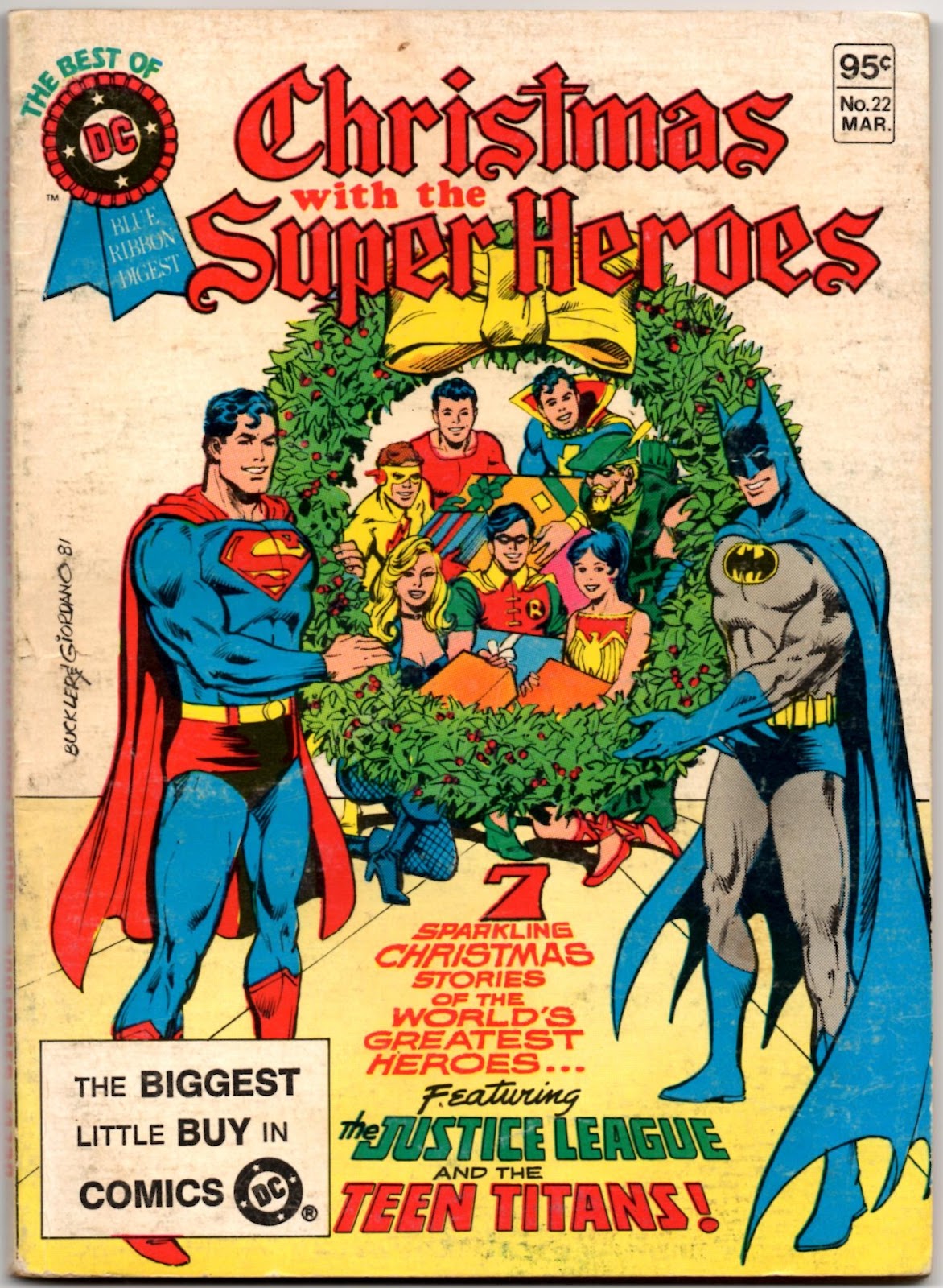
Anyway, the scans you've been reading around are taken from THE BEST OF DC (BLUE RIBBON DIGEST) #22 (03/82). The front cover above was drawn by Richard Buckler and Dick Giordano (who doubled as managing editor). This back cover was drawn by George Pérez. The inside covers have the contents, credits and indicia in front and an ad for CAPTAIN CARROT #1 in back. Everything else is a reprint except for the 18 page Sandman story intended for the unpublished SANDMAN #7. Four excerpted pages are seen in the other scans here.
While the series was being published, Kirby also did the last three issues of JUSTICE, INC. and one of RICHARD DRAGON. Also during that time, Marvel comics with October 1975 cover dates included the monthly Bullpen Bulletins Page as usual, but that particular month it had the title, in all caps, "THE KING IS BACK! 'NUFF SAID!" (The titles, before and after this, were normally silly alliteration gags that tried to use as many obscure words beginning with the same letter as possible, going as far as assigning the titles alphabetically. The August page started with 'E', September with 'F' and November with 'G'.) After SANDMAN #6, the only Kirby comics DC published were KOBRA #1 (02-03/76), which continued without him as a short-lived series, and the remaining issues of KAMANDI up to and including #40 (04/76). Robert Kanigher went back to writing "The Losers" in OUR FIGHTING FORCES. Editor Gerry Conway (since issue #33) took over writing KAMANDI with issue #38. Writing duties and editorial duties both turned over on that title several times in the first year after Kirby left and it lost its monthly status. When Jack C. Harris came on as editor the cancelled OMAC title was tied in by establishing that Kamandi was his grandson. In 1978, with Harris writing, it crossed over with Karate Kid to explain why the future of OMAC and Kamandi diverge from the future that led to the Legion Of Super-Heroes. Then came the Implosion. DC's plans to circumvent the loss of sales due to the frequent price increases of the 1970's by offering more pages (which worked well enough in 1971) went horribly wrong for reasons too complex to discuss adequately here. Over two dozen titles were cancelled in the year leading up to it (including revived versions of NEW GODS and MISTER MIRACLE) and another dozen during the three months that the page increase lasted. The last issue of KAMANDI #59 (09-10/78) was expanded by 8 pages with the first chapter of a new OMAC origin by Jim Starlin. The lead story was the first chapter of a story that would further incorporate Kirby concepts into a single continuity parallel to the other DC worlds (Earth-K?). Many of the cancelled titles, including KAMANDI, had further issues in various stages of completion when the surprise cancellations happened. Two massive volumes of photocopied pages were created (but not sold) for legal purposes. Leaked copies revealed that the next two issues (#60- 61) would have Kamandi discover a vortex that would enable him to travel to other timelines (i.e., the rest of the DCU). While there, he is grabbed by Brute and Glob, who have mistaken him for Jed, the boy who features in the Sandman adventures. In a framing story, the Sandman tells Kamandi that the story of meeting Santa Claus (meant to be published in its entirety) demonstrates that the myths in one timeline might be the reality of another.

Eventually, the OMAC back-up feature was substantially altered and ran briefly as a back-up feature in WARLORD in 1980. A year later or so, the digest above came out. The story was published again this past January as part of those final two issues of KAMANDI in the KAMANDI CHALLENGE SPECIAL (03/17). It was included in the 2013 THE JACK KIRBY OMNIBUS VOL. 2 as part of the original series, but unfortunately the nature of that collection required omitting the two issues drawn by Ernie Chua. That's why in two weeks I hope to have a post that proposes a Sandman trade collecting whatever is available for this character. I had hoped to get this post out earlier to coincide with the release of the SANDMAN SPECIAL on Wednesday, August 16th,2017, but I had lost track of the digest above. Hopefully, I'll get a chance to read the special before I get to the trade post.

Tuesday, August 15, 2017

0045: How to lay an egg

Howard the Duck pretty much ceased to exist when Steve Gerber was removed from the book. In 1978, the very public dispute that Jerry Siegel had revived with DC over Superman caused Gerber to raise questions about creative control that Jim Shooter didn't want to hear. Demands for creative control sounded to management like demands for copyrights or trademarks. Gerber was off the book, which changed frequency from monthly to bi-monthly and two fill-in issues (out of continuity) were done from his notes until Bill Mantlo could write two final issues. The title was cancelled along with tons of other Marvel titles at the beginning of 1979. By that time, Gerber was long gone, along with Jack Kirby, who dropped three titles (BLACK PANTHER, DEVIL DINOSAUR and MACHINE MAN) abruptly. They worked together on the animated "Thundarr The Barbarian" television show in 1980.

Gerber had been the only writer to handle Howard since creating him for a Man-Thing story in ADVENTURES INTO FEAR #19 (12/73), which continued into the new series MAN-THING #1 (01/74) in which Howard fell into the void of space, supposedly gone forever. Gerber hadn't created Man-Thing, but a succession of writers on that feature turned over quickly. Man-Thing's first appearance in the B&W SAVAGE TALES magazine in 1971 was written by Roy Thomas and Gerry Conway and drawn by Gray Morrow and intended to begin a regular feature, but the planned second issue didn't happen. The title would eventually restart at #2 in 1973 with new material after the stories originally slated back in 1971 were mostly cannibalized. The second Man-Thing story by Len Wein and Neal Adams, for instance, had already been incorporated as a flashback into a Roy Thomas/John Buscema Ka-Zar story in ASTONISHING TALES #12 (06/72)-13 (08/72). A third story, which takes place before the Ka-Zar story but after the flashback, was written by Tony Isabella with art by Vincente Alcazar. Bear in mind, that's four writers and four artists for three stories. That third story didn't appear until it ran in the B&W magazine MONSTERS UNLEASHED in 1974, after Man-Thing had his own title, but reads as though it was drawn from an earlier, unused script. It might have been a new story, or it might have been intended for a hypothetical SAVAGE TALES #3 in 1971.

The letters' page of ASTONISHING TALES #13 told readers looking for more Man-Thing that he would be getting his own feature soon, but couldn't confirm where. "Even we aren't sure-- but it'll definitely be in one of our presently featureless monster mags, FEAR, WHERE MONSTERS DWELL or MONSTERS ON THE PROWL." It turned out to be two months later in ADVENTURES INTO FEAR #10 (10/72) with another story by Conway and Morrow, the last before Gerber was handed the feature and also the last to be under a dozen pages, a sign that it, too, might have been planned for the B&W magazines. When Gerber took over, he not only expanded the page count but the scope of the stories as well. Man-Thing was still a swamp monster, but the readers learn that the unlikely combination of events that caused its creation were compelled to happen in order to fill a need-- to produce a guardian at the Nexus Of All Realities, a point in space that enables travel to and from any of the parallel worlds. Over the course of issues #11-19, a wizard named Dakimh uses the muck monster and a gifted magical trainee named Jennifer Kale to fight demons and illusions, all of it directed by a villain named the Overlord who intends to exploit the Nexus for conquest. It is strongly implied that the army he is building to storm the other realities is populated by characters from comic books which, by 1973, had fallen out of favor with readers: war comics, westerns, period adventures, straight science fiction, etc. The only comic characters Dakimh can gather are a Sword & Sorcery barbarian (Korrek) and an anthropomorphic 'funny animal' (Howard). As the battle takes them between one reality and another, Howard trips en route and falls into the infinite void, having served his narrative purpose of establishing that comic book 'alternate Earths' need not be limited to being variant versions of super-heroes, but could occasionally cross genres without necessitating that the characters always occupy the same continuity.
One of these guys has an Oscar. Just sayin'.

Man-Thing continued his monthly series for 22 issues plus 5 quarterly Giant-Size (twice the pages) supplements. The last two included new short stories starring Howard solo, explaining that he fell back to the last reality he had come from, but rather than land in the Everglades he wound up in Ohio. The fan reaction was positive. Thus, as the sales of monster comics waned at the end of 1975, MAN-THING was cancelled and HOWARD THE DUCK began bi-monthly with #1(01/76). After a few issues it went monthly and he began to run for President. He was the cover story of FOOM #15. After only seven issues, he was granted a Marvel Treasury Edition. Do you know who didn't get one? Iron Man, Daredevil, X-Men, Sub-Mariner, Captain Marvel, any of the western characters (still being published through the 70's), Sgt. Fury or Power Man.. It's true that some of those characters got stories in the Christmas issues, but that's hardly the same as getting your own volume. And Howard's back catalog was so thin that it required that a third of the treasury be devoted to a new story, which took place between issues #7 and #8. Around the time of the treasury and the election, George Lucas was in contact with Marvel and Roy Thomas, providing materials from which the comic book adaptation of "Star Wars" could be made ready by spring 1977 when the movie was due for release. Lucas said years later that he had long enjoyed the Howard comics and it couldn't have hurt that Gene Colan had become the regular penciller months earlier. Colan is known for having a photographer's eye when creating layouts, giving individual panels the sort of innovative 'camera angles' that would catch the attention of a film school student turned successful director in the auteur-friendly 1970's. Of course, Lucas and Howard both had pretty good years in 1977. Lucas' has been well documented; Howard introduced KISS to comics, got an annual and a syndicated newspaper strip. Pretty good for a four year old character. 1978 began almost as auspiciously, with a two-issue Star Wars parody/tribute (Man-Thing, Dakimh and Jennifer Kale return as Chewbacca, Obi-Wan and Leia, respectively). Then, as mentioned above, Gerber ran afoul for trying to run a fowl and was out the door before the Superman movie even made it to theaters.

With both the color comic and newspaper strip cancelled, Marvel moved Howard to their B&W magazine line. At first, he appeared in one-page gags in CRAZY #50(05/79)- #54(09/79) and #59(02/80) [except #52 and every third issue following it, which where reprint specials]. Then, Mantlo scripted Howard's own magazine series #1(10/79)-#8(11/80) and #9(03/91), during which Alan Kupperberg (who drew the last six months of the newspaper strip from Marv Wolfman's scripts) produced a Howard story for MARVEL TEAM-UP #96(08/80) and Steve Skeates and Pat Broderick handled the majority of the three-page Howard stories in CRAZY #63(06/80)-#77(08/81) [again, except for every third issue from 64 to 76]. A one-page Howard gag by Kupperberg turned up a year later in the all humor issue of WHAT IF...? #34(08/82), but aside from a cameo in Fred Hembeck's FANTASTIC FOUR ROAST (05/82), that was it for a year. Not only was there no feature, but there were no guest appearances.

In the latter half of 1978, fill-in stories scripted for Marvel by Steve Gerber were published, a solo Beast story in AVENGERS and a Lilith story in MARVEL PREVIEW. That appeared to be the end of his affiliation with them, except that he was scripting Hanna-Barbera stories for editor Mark Evanier under the anagrammatic pseudonym "Reg Everbest". All six of the H-B titles got the ax in the same cull that cancelled the Howard color comic. But Evanier (who has since written extensively about his Hollywood experiences) provided a route to animation, and "Thundarr the Barbarian". After the cartoon premiered in September 1980, Eclipse published Gerber's graphic novel STEWART THE RAT in November. The following year, Eclipse began publishing a B&W anthology, ECLIPSE MAGAZINE, and Gerber occasionally contributed to it. Back on fans' radar, DC took his scripts for a PHANTOM ZONE mini-series and Dr. Fate back-up feature in FLASH for 1982. Jack Kirby, not surprisingly, had kept busy, too. Pacific Comics published two series of his, CAPTAIN VICTORY and SILVER STAR, from 1981 to 1983. During that time, Kirby and Gerber collaborated on a personal project that Eclipse agreed to publish as their first full color comic, taking the place on their schedule of the May 1982 issue of the B&W magazine. It was DESTROYER DUCK, a clear and obvious protest for creators' rights and a specific condemnation of Marvel's treatment of Howard in Gerber's absence. Originally advertised to come out on December 15. 1981 [on the back of ECLIPSE #4(01/82)], it was probably out by February (the July issue of the magazine was due to ship in April, according to The Comic Reader that year). The issue of WHAT IF...? with the Howard page would have shipped to the direct market in early May with a newsstand 'on sale' date by the end of the month. Of course, Marvel had bigger problems than Howard. The emergence of publishers like Pacific, Eclipse and Capital had forced them (and DC) to offer collectors comics made with better materials and printing methods. Initially offering reprints and graphic novels, then special projects, by the time Marvel formed a Baxter paper imprint (Epic) Destroyer Duck had become an ongoing series at Eclipse, joined by SABRE by fellow disgruntled former Marvel employees Don McGregor and Billy Graham. Eclipse's color roster continued to slowly grow while Marvel cancelled the last of their B&W magazines (except SAVAGE SWORD OF CONAN), converting the last issue of BIZARRE ADVENTURES #34(02/83) into a Baxter color comic, including an eight-page Howard Christmas story by Steven Grant and Paul Smith (who had just started work on UNCANNY X-MEN). Smith also drew Howard's half-page entry in the OFFICIAL HANDBOOK OF THE MARVEL UNIVERSE #5(05/83). Butch Guice provided a Howard pin-up for MARVEL FANFARE #9 (07/83), which had a Man-Thing cover story. Then, in 1984 both Howard and Destroyer Duck disappeared. George Lucas wanted to turn his love for Howard into a movie, which would make it Marvel's first full-length theatrical feature film. Gerber was, on paper, hired as a consultant but little of his creation made it into the movie. In it, the plot centers on Howard's homeworld being another planet, not an alternate Earth, although great pains were taken to furnish scenes of his homeworld with 'duck' versions of American Earth culture. The social satire was gone, replaced by an occasional sarcastic quip. The script was provided by the producer and director, old classmates from Lucas' film school days who felt that the movie would more appropriately be animated. Every step towards getting this film into theaters seemed to involve everyone concerned second-guessing their own instincts and acting counter-intuitively, So much wasted talent, wasted money and wasted opportunity, it has become justifiably notorious in both comics and film circles. Leading into its release in August 1986, the only comics appearances Howard made in the previous three years were HOWARD THE DUCK #32(01/86) (by Steven Grant and Paul Smith again), a pin-up by Dave Sim in MARVEL FANFARE #25 (03/86) and HOWARD THE DUCK #33 (09/86) (by Christopher Stager and Val Mayerik, his original artist).

The storybook I have excerpted above was published by Grosset & Dunlap, who licensed Marvel characters for puzzle books in the late 1970's. By the way, the Read-Aloud story book mentioned on the back cover had ISBN #0448-48606-7 and the Book-And-Cassette set had ISBN #0448-48619-9. What I find strange about that is that by 1986, Marvel had expanded to publishing books and that by volume, most of them were children's books featuring many of the licensed characters which also appeared in their Star Comics and toy-based titles: Transformers, Heathcliff, Madballs, Sectaurs, Muppet Babies, etc. These came in the form of story books, paint-with-water and coloring books, activity books and so on. There was even at least one Howard the Duck sticker book called "A Walk Back In Time" (ISBN #0871-35157-9). So why was this handled by another publisher? It may have been a contractual obligation of the studio or distributor, but I simply don't know for sure.

One last note for the curious: the images scanned above were originally 8.5" X 11.0".

Sunday, June 18, 2017

0026: 'Twas Video Killed The Beast?

On the last day of March of this year a boxed set of CD's containing the collected works of the band Radio Stars was released. Entitled "Thinking Inside The Box", it was their first multi-disc collection and likely their last ever release. They simply didn't produce much in the studio, owing to the fact that they were made up of people coming from and on their way to other projects. The bulk of their recordings come from early 1977 to mid 1979, a volatile and extremely fertile period in British rock and pop music. They reunited briefly in 1982 for live shows.


After releasing three singles during 1977, Radio Stars ended the year with their first album, "Songs For Swinging Lovers"(Chiswick Records WIK 5), a limited number of which included as a bonus a "Greatest Hits Album" (Chiswick Records PROMO 2) that turned out to be a 7" single combining their first two A-sides, "Dirty Pictures" (on the left) and "No Russians In Russia" (below). Each side is illustrated with a cartoon by designer Phil Smee.


Clearly, Smee would have been right at home in Viz Magazine (no relation to the U.S. manga publisher). Callously offensive images or sleazy subject matter are ripe for the comedic approach, and it's likely that Smee would have made a name for himself for years in a venue like Viz if he hadn't already found a more lucrative career designing sleeve art for numerous bands. Cartooning seems to have been more of a hobby that came in useful at times like this, such as Nick Mason's cover for Pink Floyd's "Relics" or Chris Dreja's cover for the Yardbird's "Roger The Engineer".

I bought this used in a generic sleeve apart from the album, so there really aren't any available credits apart from what anyone could look up regarding the original singles.

Previously on "Sieve Eye Care"...