Showing posts with label Fantagraphics. Show all posts

Tuesday, August 29, 2017

0051: This Artist, This Man

This is the second half of the post "This Man, This Artist" (#0050). The title is a play on the title of one of Jack Kirby's most beloved art jobs from FANTASTIC FOUR #51 (06/66), "This Man, This Monster". (If you haven't read it and plan to, be advised that the rest of this paragraph is a Spoiler. The post continues in the next paragraph.) It takes place after the first Galactus story (#48-50) with the team trying to get their lives back to normal. The Thing is bemoaning his condition when a stranger invites him in from the rain. The stranger (who is never named during the story) turns out to be a scientist jealous of Reed Richards' success and drugs Ben then uses his own technology to turn his own body into the Thing and the Thing's body back into Ben's original form. Hoping to infiltrate the Baxter Building as the Thing to get close enough to Reed to kill him, the stranger instead learns that Reed's public persona is his own and not the hypocritical façade he had always assumed it to be. He realizes that his chances to find success on his own terms were squandered when he focused all his energy on revenge. During a crisis, the stranger sacrifices himself to save Reed. His death causes the real Ben to revert to the Thing. Each of the three men, Ben, Reed and the stranger, are either men or monsters depending on perspective. Ben fears that he is a monster, Reed is characterized as one and the stranger discovers that he is one. The stranger isn't named in the story because it gives thing a kind of universality. He didn't do wrong because of his name or who he is, but because of the limited way in which he saw things. That could have been any of us.

The thing that makes Kirby so universally name dropped is not simply because he touched a large number of people, many of whom went on to be comics creators. Fans, critics and publishers keep revisiting his work because of the wide variety of future creators who imprinted on him like ducklings. Eventually the ducklings grow up and swim away from momma, but if you could see under the water then you'd know that their legs are still kicking the same way. 31 years ago when Fantagraphics published the one hundredth issue of AMAZING HEROES they noticed that it would coincide with Jack Kirby's birthday on August 28th. They then cast a wide net asking anyone working in the industry to contribute a brief message to Jack. Dozens replied with anecdotes, observations, sketches or some combination of those. I included scans of half of them in the previous post and now here's the rest, along with my own short descriptions of the contributors.


  • William Messner-Loebs is now known primarily as a writer but he also drew his own scripts on JOURNEY, published by Aardvark-Vanaheim and then Fantagraphics. He had just concluded the series months before this article and had begun scripts on JONNY QUEST for Comico with various artists. He began several years at DC with art on WASTELAND and scripts for DR. FATE, FLASH and WONDER WOMAN. These tend to be overshadowed by scripts for THE MAXX and EPICURUS THE SAGE, both with Sam Keith.
  • Gilbert Hernandez (who often signs 'Beto') is one of several Hernandez Brothers, two of whom (Gilbert and Jaime) are markedly more prolific. Along with Mario they created all of the features in the magazine-sized anthology LOVE & ROCKETS (which was recently revived as a new series). The serialized features (like "Palomar" and "Poison River") were gradually compiled in a series of trade paperbacks under the umbrella title LOVE & ROCKETS, even though some had only tenuous or no connections to the others.

Gilberto also contributed to the all-ages anthology MEASLES and girl-band-from-space series YEAH! as well as the adult oriented BIRDLAND, LUBA and GRIP.
  • T.M. Maple was a prolific fan letter writer in the 70's and 80's, when nearly every title carried a letters' page. He died shortly after Jack.
  • Don Heck was working at Marvel when Jack returned there in 1958. On more than one occassion Don would have an extended run pencilling a feature that Jack started and left, notably THE AVENGERS and IRON MAN. He passed away about a year after Jack did.
  • Al Gordon is more likely to be the inker who started at Marvel in the late 70's rather than the Golden Age penciller, if only because he signed off here with the phrase "'Nuff Said!" He also worked on DNAGENTS for Eclipse while Jack was drawing DESTROYER DUCK.
  • This statement by Wally Wood was provided to the editors by Jim Valentino from materials prepared for a convention booklet, since Wood had died in 1981. A few years after this article when the Harvey Awards added a Jack Kirby Hall of Fame category, Wood was the first in.
  • Steven Grant started writing for Marvel in the late 70's after being published in STAR*REACH and other independents. He went from the HULK! magazine and SPIDEY SUPER STORIES to the PUNISHER mini-series (collected as CIRCLE OF BLOOD) and First Comics' WHISPER when this article came out. Two years ago he brought back Warren's "The Rook" for Dark Horse.
  • Milton Canniff was the creator of the newspaper strips TERRY AND THE PIRATES and STEVE CANYON. He was ten years older than Jack and died a couple years after this article ran.
  • Don Rico was a Golden Age contemporary of Jack's who did art for Victor Fox, Lev Gleason and others. He went to work for Marvel in 1942 to draw Captain Marvel after Simon and Kirby left. He stayed there right through the change to Atlas until the restructuring in 1957.
  • Michael T. Gilbert is most famous for refurbishing a forgotten Golden character (Mr. Monster) and has a regular column in the magazine ALTER EGO.


  • Joshua Quagmire was the creator of Cutey Bunny and now works primarily through his website.
  • Chas. Gillen, according to several online sources, was the real name of the Charlton artist who signed his work "J. Gill". I recognize Gillen's name (and stylized signature) from fanzines like this one, but I can't recall seeing his (or Gill's) name after the 1980's.
  • Stan Lee-- if I have to explain to you who Stan Lee is then you might be reading this blog by mistake. Perhaps I can interest you in a cat video?
  • [Jim] Steranko had a pair of short-lived action series for Harvey comics in 1966 when he got a chance to ink Jack Kirby on the S.H.I.E.L.D. feature in STRANGE TALES. He soon began finishing Jack's layouts and eventually was pencilling and writing the feature, taking it to a full-length monthly NICK FURY series in 1968. By the end of that year he began short stints on X-MEN and CAPTAIN AMERICA. His work on all three titles was reprinted as Baxter paper mini-series a few years before this article appeared.
  • Burne Hogarth is another artist whose comments were provided by Jim Valentino. He was both a commercial illustrator and comic book artist. He drew the Tarzan Sunday newspaper strip for over a decade, but today is probably best known for a series of instructional books about drawing anatomy, especially anatomy in motion.
  • Roy Thomas became a comics fan in the 1940's, contributing to the pioneering fanzine ALTER EGO, and currently edits the modern version of it published by TwoMorrows. In the mid-1960's he began a long association with Marvel, usually succeeding Stan Lee's writing duties on various titles as the company's line expanded and Lee's editing duties became more demanding. Eventually, he succeeded Lee as Editor-In-Chief as well. Most notably, he took over X-MEN and AVENGERS. He also talked the company into abandoning it's policy of avoiding licensing characters in order to adapt the first CONAN comics, which he wrote for over a decade. He also wrote the adaptation of STAR WARS in 1977. In the 1980's he became DC's go to guy regarding Golden 

Age characters, scripting ALL-STAR SQUADRON, YOUNG ALL-STARS and INFINITY, INC. When CRISIS eliminated that history, he was given a new monthly title, SECRET ORIGINS, to write or edit a new one. He may be the only person working in comics to have created as many durable, recurring characters as Stan and Jack.

  • Jaime Hernandez, who often signs as "Xaime", is one of the Hernandez Brothers (see Gilberto, above). Jaime did a number of mini-series that spun off supporting characters from LOVE & ROCKETS, such as PENNY CENTURY and WHOA, NELLIE! and numerous album covers.
  • Don Simpson is the creator of the long-lived super-hero parody "Megaton Man", but Dover Publications has just recently collected his science fiction opus BORDER WORLDS into a single volume for the first time ever.
  • Jonathan Peterson became an editor at DC around the time that this article ran. By the time he left in 2000 he had also done some scripts.

  • Rick Veitch is a writer and artist who has worked for Marvel and DC but might be best remembered for his creator owned work published with smaller companies, such as BRAT PACK, MAXIMMORTAL and RARE BIT FIEND. In the 1970's he left undergrounds to work in the majors, doing art for SGT. ROCK (DC), colors for FLASH GORDON (Western), letters for STAR WARS (Marvel) and all three for his own scripts in HEAVY METAL. After providing art on SWAMP THING for a year and a half he took over scripting when Alan Moore departed, staying for another year and a half. His website is both beautiful and easy to navigate.
  • Gil Kane was working at DC in the 1950's when Jack left to join Marvel. At about that time, Kane was playing a huge part in launching DC's Silver Age, leaving behind "Rex the Wonder Dog" and "Trigger Twins" for the new "Green Lantern" and "The Atom". Beginning in the mid-60's Kane became one of the select few to work at both Marvel and DC simultaneously. He was still working for both when this article was published and continued to do
so right through the 90's. He passed away in 2000.
  • Mark Alexander was an inker discovered by DC's title NEW TALENT SHOWCASE, but at the time of this article was working on one of Marvel's "Official Handbook" series, which must have forced him to think about numerous Kirby caharcter designs.
  • Scott Shaw! is (like Fred Hembeck and Sergio Aragones) one of those rare humor cartoonists who becomes tied into super-hero comics for reasons that become obscured with time. His anthropomorphic comics appeared in QUACK! (published by Star*Reach) along with Dave Sim, Frank Brunner, Steve Leialoha and others. He worked on Marvel's Hanna-Barbera titles in the late 70's while Jack was there (see the Howard the Duck post, #0045) He was drawing CAPTAIN CARROT for DC while Jack Kirby was doing CAPTAIN VICTORY for Pacific Comics. Shaw brought unpublished stories of features from QUACK! to Pacific, which became WILD ANIMALS, but Pacific went under before the second issue was ready. At the time of this article he was probably working in animation, but clearly made time to write a substantial entry. In fact some of the submissions for this issue were so long that they were published as full articles in this same issue. They include "Kirby!" by Doug Moench, "Jack Kirby's Gods & Heroes" by Greg Potter, "The King And I" (an interview) by Mark Evanier, "10 Great Jack Kirby Stories" by Richard Howell, "That Old Jack Magic" by Greg Theakston and reviews of key issues by R.A. Jones in the same style normally used to review current comics.
Well, I hope that these two posts provide you with several days of amused reading. I also hope that Gary Groth doesn't have a conniption fit over me reproducing so many pages that he never had any intention of reprinting in a million years anyway. It'll also give you something to point to the next time someone says, "You can't get that many people with that many different tastes to agree on anything..."

Monday, August 28, 2017

0050: This Man, This Artist

Jack Kirby lived to be just over 76 years old. That's how long ago Captain America started punching Nazis. On Monday, August 28th, 2017, it will be Jack Kirby's 100th birthday.

The cover on the left is for AMAZING HEROES #100 (Aug.1st, 1986), a fanzine published by Fantagraphics. AH began as a B&W magazine, the same size as Fantagraphics longer lived fanzine THE COMICS JOURNAL, although I remember it being thinner. As TCJ began to devote more space to the legal and ethical issues facing comics publishing and retail, AH took over the materials more commonly sought by fans, such as release dates, previews of upcoming series and events, histories of Marvel and DC heroes and news about licensing for film and merchandise. Whereas TCJ would publish 50 page career spanning interviews with writers and artists, AH would interview them about recent projects and career highlights. Beginning with issue #14, AH shrunk down to standard comic book dimensions. It was still printed in B&W on newsprint, but of the two fanzines it was the one whose readership more likely included comic fans who didn't buy anything else of magazine dimensions that wasn't designed for a bookshelf. For their convenience, AH would then fit in a comic storage box.
Seeing as how this Kirby tribute issue is 31 years old, the people paying tribute may not all be familiar to modern audiences, although most should be. I'm not going to make any assumptions about who you'll recognize, so...

  • Steve Rude is an artist probably best known for drawing Mike Baron's Nexus (as his first and definitive penciller). Look for Rude's own character The Moth. He also drew a MISTER MIRACLE Special for DC that was on sale in January following this article.
  • Richard Corben emerged from undergrounds to be one of the defining contributors to the American HEAVY METAL. His SHADOWS ON THE GRAVE mini-series for Dark Horse is ending soon.
  • Robert Loren Fleming is a writer who collaborates with Keith Giffen on AMBUSH BUG.
  • If you read comics, you already know who Frank Miller is.
  • Michael Kraiger had just started contributing the feature "Zone" to Fantagraphics' anthology THREAT months before this article. It moved to Dark Horse a few years later. He then became an editor at Marvel.
  • Jim Baikie worked on 2000A.D. and other Fleetway titles in the U.K. before pencilling DC's ELECTRIC WARRIOR.
  • Jim Rohn contributed his "Holo Brothers" feature to Fantagraphics' THREAT anthology shortly before this article and their Monster Comics imprint published the 10 issue miniseries that continued the story.
  • Gary Fields regularly contributed "Enigma Funnies" to THREAT but lettered comics for several other creators.
  • John Romita briefly drew Captain America stories in the fifties.When Kirby left Marvel in 1970, Romita was assigned to follow him on FANTASTIC FOUR. He's probably best known for his work on AMAZING SPIDER-MAN.
  • Jack Katz created the genuine epic FIRST KINGDOM, currently complete in hardcover from Titan.
  • Bob Laughlin self-published KITZ 'N' KATZ, which was distributed by Eclipse in the 80's.
  • Arthur Byron Cover is best known as a science fiction author who has occasionally worked in comics, notably with Harlan Ellison on DAREDEVIL #'S 208-209.
  • Flo Steinberg was, I think, technically the receptionist at Marvel in the 60's, but according to Stan Lee and others she effectively handled just about every task around the office not directly involving comics production, such as sorting fan mail and keeping the fan club memberships organized. At the end of the 60's she left for a non-comics editing job but was involved in undergrounds and early independents, eventually becoming a publisher herself.
  • Rick Norwood was an editor for COMICS REVUE, a fanzine from the publishers of COMICS INTERVIEW.
  • Dennis O'Neil is a writer who worked for Marvel briefly in the mid-60's and more prominently in the 80's but made comics history with Neal Adams for their work on Batman and Green Lantern in the early 70's.
  • Julius Schwartz was an early fan of science fiction pulps in the late 1920's and went on to become an editor at DC, where he revived the company's Golden Age heroes in the late 50's as s-f based characters, creating the Justice League to replace the Justice Society.

  • Barry Windsor Smith became famous for drawing the first CONAN THE BARBARIAN comics in 1970. Before that, he drew in a cruder style that looked like a Kirby imitation. In just a few years his art became both original and beautiful but he kept an affection for Kirby's characters. Two years before this article he finished and inked Herb Trimpe's pencils on the MACHINE MAN mini-series. In the 90's he created ARCHER AND ARMSTRONG, RUNE and STORYTELLER.
  • Dave Garcia was the creator of Panda Khan, which was a back-up feature in A DISTANT SOIL before this article and afterwards became its own title from Abacus Press.
  • Monica Sharp scripted and edited the Panda Khan stories, often with Garcia.
  • Bob Wiacek is an inker who did some work at DC in the mid-70's just Kirby was leaving, but in 1977 began a long tenure at Marvel working on just about everything, including STAR WARS and IRON MAN.


  • Dave Gibbons is a British artist who drew for both 2000 A.D. and DOCTOR WHO WEEKLY from the beginning of each. In America, he became famous for WATCHMEN with Alan Moore and GIVE ME LIBERTY with Frank Miller.
  • Kevin O'Neill is another British artist, probably best known for MARSHALL LAW and LEAGUE OF EXTRAORDINARY GENTLEMEN. That's his illustration of a 'Marshall Law' type gun on the left.
  • Mike Royer is a longtime inker of Kirby who has followed him through several publishers for about 20+ years.
  • Stephen DeStefano was doing the DC title 'MAZING MAN when this article came out. He went on to do brilliant humor comics (including INSTANT PIANO and JINGLE BELLE) whose audience was dwarfed by that for his animation work (including "Ren And Stimpy" and "The Venture Brothers").
  • Charles Meyerson wrote text pieces for First Comics in the 80's.


  • Steve Parkhouse is a British artist who sold some scripts to Marvel in the late 60's. When Marvel created a U.K. branch in 1972 it was initially all reprints, but Parkhouse was one of the early writers they called on when easing into publishing original stories. He wrote three different features for HULK COMIC (later HULK WEEKLY) but also drew his own scripts on the SPIRAL PATH feature and Alan Moore's BOJEFFRIES SAGA for Fleetway/Quality's WARRIOR. Eclipse reprinted SPIRAL PATH as a mini-series while this article was out. Today you can see his art in Dark Horse's RESIDENT ALIEN (highly recommended.
  • Bill Mantlo was a prolific writer at Marvel in the mid-70's to mid-80's, probably most famous for MICRONAUTS and ROM, but also wrote INCREDIBLE HULK for years and all of the B&W magazine version of HOWARD THE DUCK. He also created Rocket Raccoon for an uncompleted science fiction serial. He has been unable to write for 25 due to traumatic injury by a car.
  • Vince Argondezzi drew NEXT MAN for Comico before this article came out and drew INFINITY, INC. for DC afterwards.
  • Rick Bryant iinked Keith Giffen's pencils on a one shot comic from Lodestone called THE MARCH HARE, which Giffen co-wrote with Robert Loren Fleming.
  • Scott Hampton had completed SILVERHEELS for Pacific comics two years before this and adapted Robert E. Howard's 'Pigeons From Hell" for Eclipse two years later. Not to be confused with brother Bo Hampton, Scott is currently finishing P. Craig Russell's layouts in AMERICAN GODS: SHADOWS from Dark Horse.
  • George Pratt works as much (if not more) as an illustrator than as a comic book artist. Like Hampton, he often paints comics and is probably best remembered for the graphic novel ENEMY ACE: WAR IDYLL.
  • Larry Marder is the creator of TALES OF THE BEANWORLD, originally with Eclipse and now with Dark Horse. He was made Executive Director of Image to overcome their early chaos.
  • Steve Ringgenberg is a freelance comics writer who also writes nonfiction about comics industry.
  • Dark Horse Comics had only just started publishing when this article was released. The lineup shown here is, left to right, Concrete (by Paul Chadwick), Boris The Bear (by James Dean Smith), Garrett from "Mindwalk" (by Randy Stradley and Randy Emberlin), Mercy St. Clair from "Trekker" (by Ron Randall), Conrad from "Black Cross" (by Chris Warner), Roma (by John Workman) and Charlie from "Hellwalk, Inc." (by J.M. DeMatteis and Mark Badger). Boris had his own series and the others appeared in DARK HORSE PRESENTS. Two of them, however, hadn't even debuted when this illustration ran. "Trekker" would debut in #4 (01/87) and "Roma" would debut in #5 (02/87). The "Hellwalk, Inc." feature didn't start until issue #2 (undated; probably September), but the image of Charlie used here can be found in #1 as part of a small ad teasing the next issue. Also in #2, the art seen here is also used in a two page ad in the centerfold.

  • J.M. DeMatteis is a comics writer who was writing war and horror stories for DC's anthologies in the late 1970's and eventually doing some super-hero back-up stories. In the early 80's he worked at Marvel, including writing DEFENDERS and CAPTAIN AMERICA. When this article came out he was writing the last stories of the original JUSTICE LEAGUE OF AMERICA series and would go on co-write, with Keith Giffen, the new JUSTICE LEAGUE series that would follow the LEGENDS mini-series. Those would be some of his best remembered scripts, along with the GARGOYLE mini-series for Marvel and MOONSHADOW and BLOOD: A TALE, both minis for Marvel's Epic line and both later reprinted by DC's Vertigo.
  • Scott McCloud is now best known for the nonfiction comics-format book UNDERSTANDING COMICS, but at the time of this article he was known primarily as the creator of ZOT! from Eclipse.
  • Jerry Ordway is both a writer and a penciller on numerous titles but his close association with Superman was beginning to develop after this article ran and ALL-STAR SQUADRON was cancelled.
Whew! And that's just half the article! Give yourself some time to read some Jack Kirby stories today and I'll complete this article during the week. Enjoy!

Tuesday, July 11, 2017

0033: Cast in Aluminum, Then in Lacquer

Reading "Like A Velvet Glove Cast In Iron" today, a person who began reading alternative comics in the past ten years might think it was a proposal for a cable TV series. Think "Preacher", "Fargo", "Walking Dead", "American Horror Story" and especially the return of "Twin Peaks". But when the story was originally published, it was not only inconceivable that it could be adapted for television, some people had a hard time believing it was being published as a comic.

The story actually predates not only those TV series but their source materials as well. If it had an influence in anything, it would be in the "Twin Peaks" predecessor "Blue Velvet" (1986), also the creation of David Lynch. The title, however, comes from the dialogue in Russ Meyer's "Faster, Pussycat! Kill! Kill!"

Dan Clowes wrote and drew "Like A Velvet Glove..." as a serialized lead feature in his Fantagraphics series "Eightball". This is the same series that became the source for "Ghost World", "Art School Confidential" and "Ice Haven", which became two movies and a short. So, finding this "Original Soundtrack" would only serve to reinforce the suspicion that there was a movie in the making here, no? No. That is, there was speculation about it being adapted into a film in the 90's when everything from "The Mask" to "Tank Girl" was getting into national chain theaters, but this isn't intended to be a soundtrack to a movie. It was written to be a soundtrack to the comic.

Dan Clowes (left) and Tim Hensley (right), as drawn by Clowes


Tim Hensley is the son of Tom Hensley, decades-long keyboardist for Neil Diamond and others. He was also one of several veteran session musicians who recorded a synthetic-instrument Christmas album as Joy Circuit. The album, "Crystal Clear Christmas", was released on the Modern Art label in 1987, but Modern Art was a small independent with little in the way of infrastructure so the manufacturing and distribution was done by Word, Inc., an Irving, Texas-based gospel label (it has since changed hands and has offices in Nashville). Word would eventually be known for releasing early recordings of artists like Michael W. Smith and Amy Grant, but in the mid-80's if it was known at all it was as the home of both revival tent acts (the Bill Gaither Trio) and "contemporary Christian" acts (such as the tone-deaf Sandi Patty). Given the irreverent liner notes on "Crystal Clear Christmas" [for the song "We Three Kings (of ornament R)" they add, "they journeyed onward in search of a full house"], it seems incredible that the ordinarily humorless Word would green light this. Maybe they don't play poker. The fact that it's a jazz album of holiday standards released on a fairly right-wing label at the height of the Reagan administration with sub-Ken Nordine liner notes makes the whole thing feel like an ironic satire dreamed up by Clowes. So, apparently son Tim shares his father's sense of humor. In 1987, Tim Hensley was a college student and comics fan with a band. He contacted Daniel Clowes to see if it would be possible for him to draw the jacket art, based on the aesthetics of Clowes' late 80's series "Lloyd Llewellyn". Apparently, Clowes agreed that they's be a perfect match, since he drew the front and back cover art for the vinyl LP "Split", released under the name Victor Banana [Splat-Co Records 100, 1989]. It was Clowes who then suggested to Hensley that he reciprocate by writing a soundtrack to a comic book series that Clowes was in the process of starting. The series became "Eightball", published about three times a year (initially) by Fantagraphics. Although they had no cover dates, the indicia date for issue #1 was October 1989. It was 32 pages without ads and included the new character Young Dan Pussey, old favorite Lloyd Llewellyn and the now-classic "Devil Doll" short. The lead feature was "Like A Velvet Glove...", in which a man named Clay discovers that his ex-wife appeared in a fetishistic porn film and goes on a road trip to find her. Instead he gets sidetracked and effectively trapped in a bizarre small town that seems to be a microcosm of conspiracy theories come to life.

(exterior of CD booklet)
According to Hensley, the song "O'Herlihy" existed in 1989, but for whatever reason had not been included on the LP "Split". Clowes incorporated the character into the story in order to ensure it would be included on the soundtrack. Then, Clowes continued to keep Hensley updated on the progress of the story and Hensley continued to write songs inspired by specific elements in it. In the middle of that, they both contributed to the faux lounge act Rube Ruben's 7" single "Shmendrick" (Sympathy For The Record Industry SFTRI 117) and the second volume of Ernest Noyes Brookings poems set to music, both in 1991. As 1993 began, the story finally reached its enigmatic end in Eigthball #10 (02/93), at 130 pages not including covers and promotional pieces. It was the only feature in all ten issues; Lloyd had given way to multiple short pieces after 1990. The first full-color Eightball T-shirt featured "Velvet Glove" characters and it was the basis of a silkscreen, mug and even a rubber stamp of Tina (the potato shaped mutant girl who appears on the CD booklet cover, above). Paul and Tina even appear in the two-page meta-story "Eightball" in issue #9.

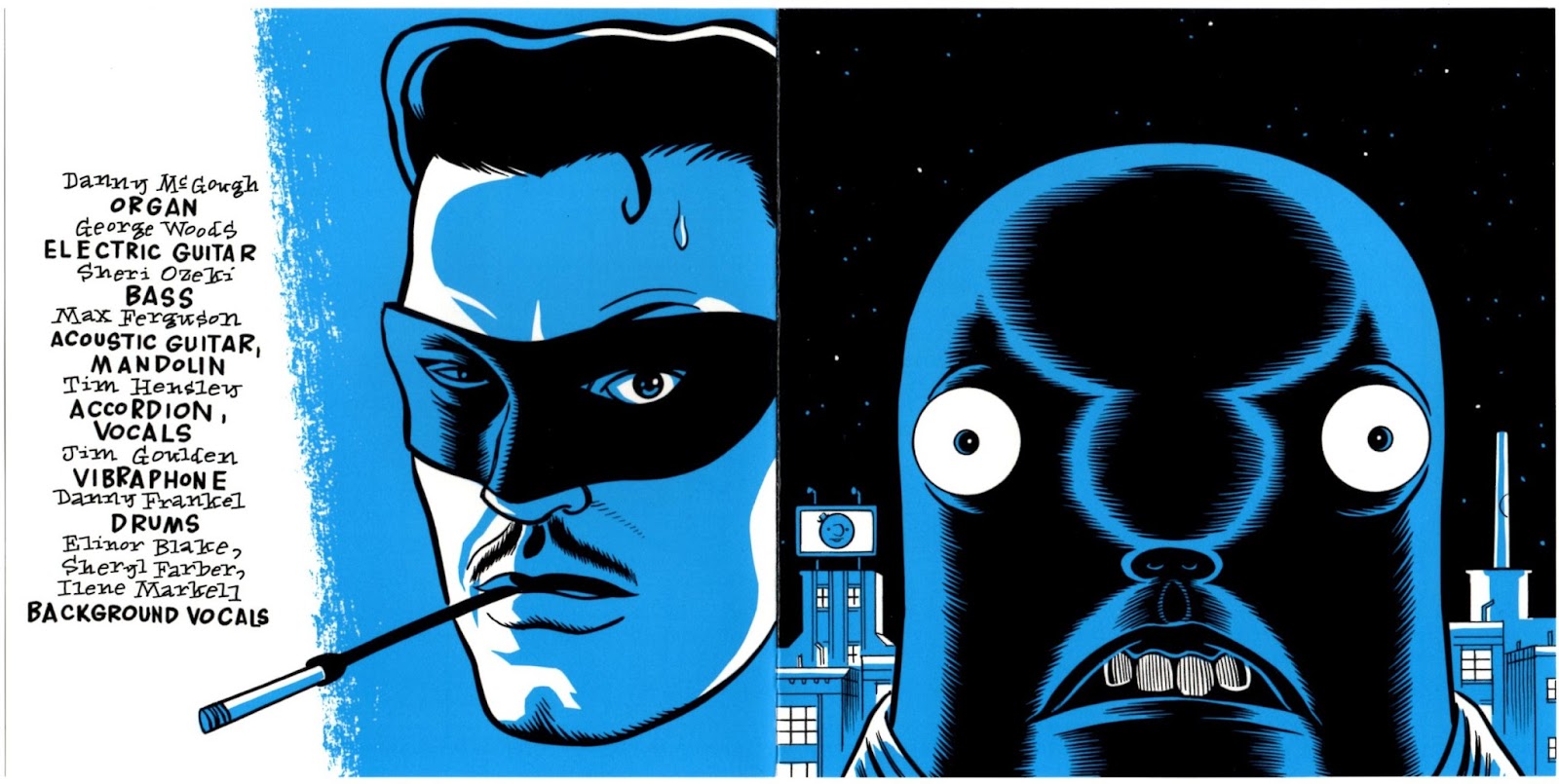
(interior of CD booklet)
Eightball #11 (06/93) included the four-page satire "Velvet Glove: The Movie", detailing what a nightmarish disaster Hollywood would make out of any attempt to adapt the story to film, followed by a half-page ad for the 10" LP of the soundtrack. For the record, the front and back of the vinyl version were both completely different original Clowes art. The 500 copies disappeared pretty quickly and a year later Eightball #14 (no date; late 1994) offered the soundtrack on CD in the letters' page. The disc is easier to find (I think the print run was a few thousand) and definitely fits the story, although curious fans should be aware that it's about 16 minutes long (the "Split" album offered 20 songs in 35 minutes, so it's consistent with Hensley's style).

Hensley continued playing music, appearing as "Vic Hazelnut" (a nod to Vic Chesnutt) on a single by April March (the sleeve had liner notes by "Ren and Stimpy" creator John Kricfalusi) shortly after the soundtrack was completed. Also in 1993, the Joy Circuit Christmas album was reissued on the Jenkins Peabody label.
The label's next release appears to be the last Hensley/Clowes collaboration I can find. In 1995, Peabody-Jenkins released the CD "Refrains" under the pseudonym Neil Smythe. Reportedly it didn't sell as well, but CDBaby probably still has copies if you're interested. After 2000, Hensley made a belated debut as a cartoonist in his own right after working as a film editor. To date, his most successful effort is probably "Wally Gropius" (Fantagraphics, 2010). Clowes, of course, gradually turned Eightball from a one-man anthology into a series of one-shots in different formats and eventually stopped using the umbrella title sometime after it had already lost its definition. And Terry Zwigoff helped him evade the worst aspects of translating his works to film. In fact, odds are I'll probably stumble across another "other media" post topic involving Clowes before the end of the year.

Previously on "Sieve Eye Care"...